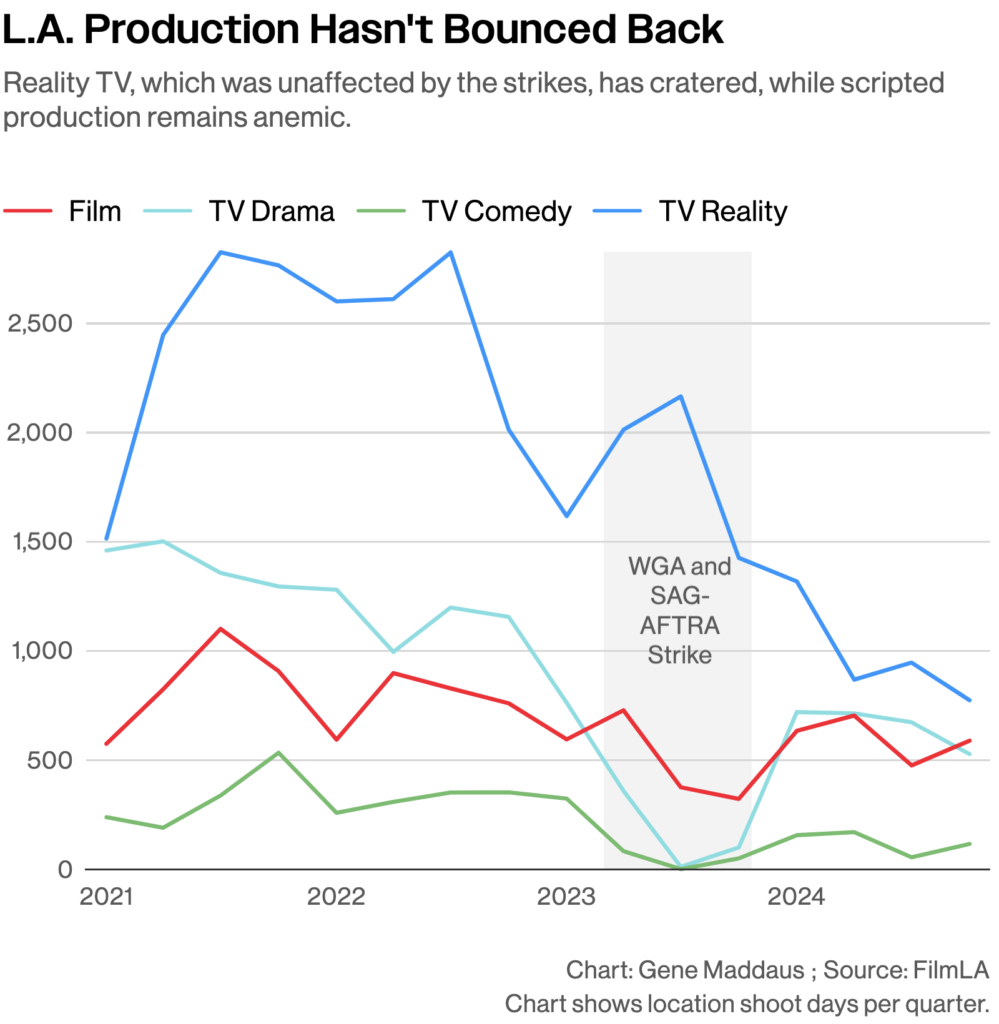










Reporting Industry Trends Using Quantitative Research The graph below, originating from the Variety article titled, “After L.A. Fires, Bringing Production Back Has Become More Urgent Than Ever” is an example of quantitative research used to support the writer’s reporting about the state of film and television production after the California wildfires. This graph is an example of quantitative research because it utilizes empirical data to quantify the amount of production by tracking the number of shooting days per quarter. While the graph quantifies the fluctuating amount of production from 2021 to 2024, the article’s authors utilize this quantitative research to support their reporting on the state of film and television production in Los Angeles after the California wildfires. For this article, quantitative research effectively supports the authors’ reporting about production in California in addition to interviews with industry insiders. Personally, I am the type of film student who enjoys reading trade magazines like Variety and The Hollywood Reporter because I am able to learn about multiple current issues that the industry navigates in a more accessible form versus reading academic literature. Furthermore, I enjoy reading film industry trade magazines because I learn more about currently circulating movies and television shows, often directly from […]“Reporting Industry Trends Using Quantitative Research”
Laugh Now, Panic Later Key Term: Rhetorical Methodologies Subheading: Communication Research This cartoon relates to Chapter 6 because it demonstrates Rhetorical […]
When the Costs Outweigh the Benefits Key Term: Social Exchange Theory Subheading: Communication Theory I chose this cartoon for Chapter 5 because it demonstrates the concept of […]
AI Elevating Data Management in Finance Artificial Intelligence is reshaping finance, defying traditional ways, and ushering in a new level of data management. Regardless of size, firms now harness AI to make bold moves in handling data with keen precision. The smarter our tools get, the more the complex data becomes an opportunity rather than a hurdle. AI in Action: No More Clutter Gone is the chaos of messy spreadsheets. With AI, financial institutions now wield a powerful tool to clean, organize, and prioritize data faster than ever. Say goodbye to human error and hello to seamless transaction insights. This is a game-changer. Instant reports and real-time forecasts have emerged as the norm. AI doesn’t second-guess; it cuts through the noise with lightning speed. Despite the benefits, AI implementation isn’t devoid of challenges. One concern many firms face is the data integration between legacy systems and new AI frameworks. Often, systems can operate in silos, creating latency in data processing. Overcoming this requires smart bridging solutions that unify disparate data sources into a cohesive, dynamic whole. As financial systems become more interconnected, ensuring the security of information becomes paramount. One aspect of this involves employing AI cybersecurity solutions. These specialized systems are designed to protect data by adhering to strict regulatory standards while providing a dedicated AI-driven infrastructure for sectors prone to compliance issues. Another noteworthy aspect is how AI assists in regulatory compliance. It continuously monitors transactions for adherence to legal standards, automatically flagging inconsistencies. This not only streamlines compliance processes but also builds trust among stakeholders by ensuring adherence to regulations. The automation of these checks allows for reduced manual work while increasing the accuracy and reliability of compliance efforts. The use of AI models for predictive analytics extends beyond basic reporting. These models can simulate various financial scenarios, offering decision-makers a chance to evaluate potential outcomes without the associated risks. This leads to more informed strategic planning and ultimately, better positioning in the competitive market. Fraud Detection: On-Point and Always Alert Fraudsters are smart, but AI is smarter. Surveillance systems powered by AI evaluate billions of transactions to detect any signs of suspicious activities. The result? Fraud detection isn’t reactive anymore, it’s ahead of the curve, predicting and preventing threats before they strike. With AI’s learning capabilities, fraud detection measures can become increasingly refined. Over time, AI systems grow adept at identifying not just blatant fraudulent activities but also subtle, less obvious deceitful behavior, enhancing the security framework and providing customers with peace of mind. Investment Decisions Get a Tech Boost AI sifts through historical data to identify trends and patterns, offering a goldmine of insights for making investment decisions. AI transforms hunches into data-driven strategies. The secret sauce is AI’s ability to predict market changes faster and more accurately than traditional methods. The once exclusive data arena now opens its doors far and wide. Risk Management is Smarter Now Forget the old days of juggling risks on your own. AI tags and monitors every detailed transaction, flagging anomalies that might slip past the human eye. This proactive approach to risk is turning heads. With AI playing defense, finance pros can finally focus on growth, innovation, and strategy. The true potential of AI in risk management lies in its ability to learn and adapt. By observing transactional patterns over time, AI systems enhance their precision in recognizing emerging risks. This process ensures that institutions are nimble, responding to threats with tailored solutions grounded in real-time intelligence. Another exciting development is the use of AI in conducting sentiment analysis. By examining unstructured data from news sources, social media, and financial reports, AI can predict market trends and potential risks before they become apparent. This adds another layer of intelligence and responsiveness, allowing organizations to act, rather than react, in the face of volatility. Customer Service: Personalized and Predictive Banking isn’t just transactions anymore; it’s an experience. AI takes personalization to a whole new level, analyzing customer behavior to tailor services and create unbeatable customer satisfaction. AI anticipates customer needs and provides solutions even before customers call. That’s the difference between guessing and knowing. Challenges Are Real But Worth It AI isn’t perfect. Integration challenges and privacy concerns persist. Data security and ethical considerations remain hot topics. But these challenges are mere speed bumps. Finance firms must lean in, adapt, and innovate, or risk being left behind. Change is hard, but the payoff is worth every effort. The Way Forward The message is clear: AI in finance isn’t a choice; it’s the future. Embracing AI is the path to staying competitive and sustainable in this data-driven era. Financial institutions must decide now or risk falling behind. As AI continues to transform data management, there’s a singular truth: ad […]“AI Elevating Data Management in Finance”
In this episode of Twilight Talks, Kevin Moore talks to painter Marcus Brutus about immigrant alienation, branding, and creating a Black legacy through painting.
Email us at [email protected] so we can respond to your questions and requests. Please email from your CUNY email address if possible. Or visit our help site for more information:
No Comments
